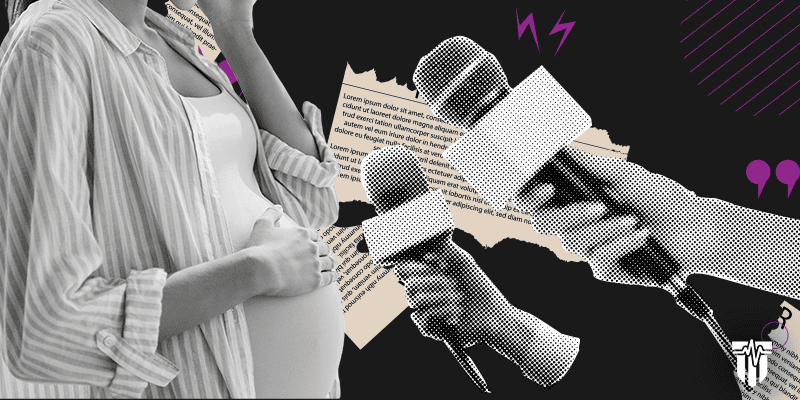
For years, anti-Life activists have claimed that Pro-Life laws prevent doctors from providing life-saving care to pregnant women. They argue that abortion is necessary to save a mother’s life and warn that women will die because physicians are too afraid of legal consequences to intervene. In short, they claim abortion bans sacrifice mothers to protect their children. These claims are simply untrue and ultimately create public confusion, which actually leads to women being afraid to seek care or doctors being unnecessarily nervous about providing legal life-saving care.
Earlier this year, the Journal of the American Medical Association (JAMA), a decidedly left-leaning publication, admitted that “from 2018–2023, no significant overall increase in pregnancy-associated mortality was found in ban vs. non-ban states.”
In every state with Pro-Life laws, including Texas, medical providers are allowed to act to save a mother’s life when it is at risk.
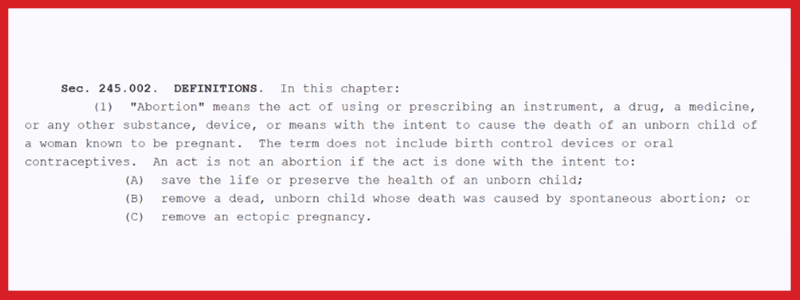
Under Texas law, an abortion is defined as the intentional ending of a preborn child’s life. This definition explicitly excludes treatment for miscarriage, where the child has already died. Here, the baby has tragically passed away naturally and must be removed. This is not like elective abortion, which involves killing and removing a living child. The definition also excludes efforts intended to save the life of the unborn child or to treat ectopic pregnancy. Since these forms of medical care are not legally considered abortions, they are not restricted by Texas Pro-Life laws.
To further clarify this, the Texas Legislature passed the Life of the Mother Act (Senate Bill 31) to correct these misunderstandings in 2025. This law requires doctors and hospital attorneys to take continued education courses to ensure they know the law allows intervention in tragic cases when the mother’s life is in danger. Even after that law passed, some doctors have wrongly hesitated to treat women, such as in the case of Lynn Callaway. Callaway was suffering a miscarriage, and her doctors turned her away even though they could clearly act to save her under the law. If she died, media outlets would surely have used her as an example for their faulty thesis that Pro-Life laws lead to maternal mortality. Physicians who refuse to act to legally care for mothers facing miscarriage should face malpractice accountability.
Thankfully, maternal deaths due to emergent pregnancy complications are becoming increasingly rare. Once accounting for 90% of maternal deaths, this category now accounts for only about 30% of maternal deaths. The Charlotte Lozier Institute estimates that half of maternal deaths are a result of poverty, substance abuse, and/or pre-existing health conditions such as obesity, diabetes, and malnutrition. The states with the highest female death rates also experience the highest rates of maternal deaths, regardless of abortion policy.
After the Supreme Court overturned Roe v. Wade in 2022, anti-Life activists insisted the United States would immediately see an increase in maternal deaths and pregnancy complications in states with abortion bans. Four years later, there is no evidence to confirm these fears. Nevertheless, liberal media outlets are incentivized to under-report maternal mortality data in pro-abortion states, and over-report data in Pro-Life states, promoting fear over facts, and using preborn babies and their mothers as political pawns.
Story continues below.

Don’t miss important Pro-Life stories like this.
>> Get the Pro-Life Weekly Highlight just once a week:
For example, the Texas-based Austin American-Statesman published an article in 2024 entitled, “How Can Texas Improve After Maternal Mortality Report Shows Increase in Deaths?” This article explicitly over-reported Texas maternal death rates to support the narrative that Pro-Life laws harm women. The Statesman references data released by Texas’ Maternal Mortality and Morbidity Review Committee (MMMRC), the state agency responsible for monitoring and evaluating maternal health in Texas. As stated in the official 2024 report, “If COVID-19 deaths are excluded, the updated MMRs [maternal mortality rates] would be 24.2 per 100,000 live births in 2020, and 23.0 per 100,000 live births in 2021.”
The Statesmen’s article falsely represents the COVID-inclusive numbers as Texas’ actual maternal mortality rate, claiming, “In 2020, the deaths per 100,000 live births were 27.7. In 2021, that rate jumped to 37.7.” The Statesmen went on to partially attribute the increases to the passing of the Texas Heartbeat Act (SB 8) in 2021.
Not only do the actual numbers reported by the state of Texas reveal only a modest increase in maternal deaths. The Statesmen also failed to mention that America’s overall maternal mortality rate for those years increased by a similar margin. This is not unique to Texas.
As recorded by the Center for Disease Control (CDC), the United States’ maternal mortality rate, including COVID-19 deaths, jumped from 17.6 in 2019, to 24.9 in 2020, and 33.2 in 2021. These changes are identical to Texas’ COVID-19 numbers, jumping from 17.2 in 2019 to 27.7 in 2020, and so on.
Even one maternal death is too many, and Texas must continue working to improve outcomes for mothers. But the data makes one point clear: abortion laws were not the driving factor behind the temporary increase in maternal mortality.
In April of 2025, a report released by the Gender Equity Institute erroneously claimed that maternal mortality in Texas rose after the Dobbs decision, falsely asserting that women were “2x more likely to die” in states where abortion was banned than in abortion-permissive states. Yet that same report cites CDC data showing that America’s overall maternal death rate actually dropped after the Dobbs decision, from 23.2 in 2022 to 18.6 deaths in 2023. This does not necessarily mean that the abortion ban led to a decrease in maternal deaths, but it certainly disproves any claim that more women died as a result of abortion restrictions.
Overall, this is good news. The U.S. maternal mortality rate is dropping to pre-COVID levels, while the Dobbs decision allowed Pro-Life states to protect preborn Life.
But we can’t stop here. Since the overturning of Roe, U.S. abortion numbers have continued to climb, with a record 1.3 million babies killed via abortion in 2025. Despite Texas’ strong Pro-Life laws, Texas women are still obtaining abortions via out-of-state travel and mail-order abortion pills.
The Obama-era FDA eliminated most reporting requirements for abortion pill complications, requiring reporting only if the mother dies. The Biden administration went further, removing the in-person visit requirement to obtain these drugs. Today, abortion providers often instruct women to report complications as miscarriages, making it extremely difficult to track risks and to enforce Pro-Life laws. If policymakers are serious about protecting women’s health, this lack of oversight should be deeply concerning.
Urge Trump to stop mail-order abortion pills.
Pro-Life laws were never about choosing between mother and child. They are built on the principle that both lives matter and both deserve protection. Lawmakers should continue strengthening protections for both mothers and their children, including restoring common-sense safeguards on abortion drugs, improving maternal health care, and addressing the root causes that place women at risk in the first place. Every mother deserves real care, and every child deserves a chance at life.
Thank you for reading this story! If you support our Pro-Life ministry, chip in with a life-saving contribution today!